
The regulatory pathway for a drug–device combination product (DDC) in the EU depends on the product’s intended purpose, how the product achieves its principal intended action and how the medicinal and device components are combined. A key consideration is whether the medicinal product provides the principal action or an incorporated medicinal substance has an ancillary action to the device. This assessment helps determine whether the product is regulated primarily under the medicinal product legislation (Directive 2001/83/EC) or the Medical Device Regulation (EU) 2017/745 (MDR).
Drug–device combination products bring together two different regulatory frameworks, development approaches and areas of expertise. Although the scientific and technical principles behind these products may be well understood, projects can face delays when regulatory requirements are not considered early enough. Questions around classification, clinical evidence, technical documentation, quality requirements and post-market obligations can become significant challenges if the regulatory strategy is not aligned from the beginning.
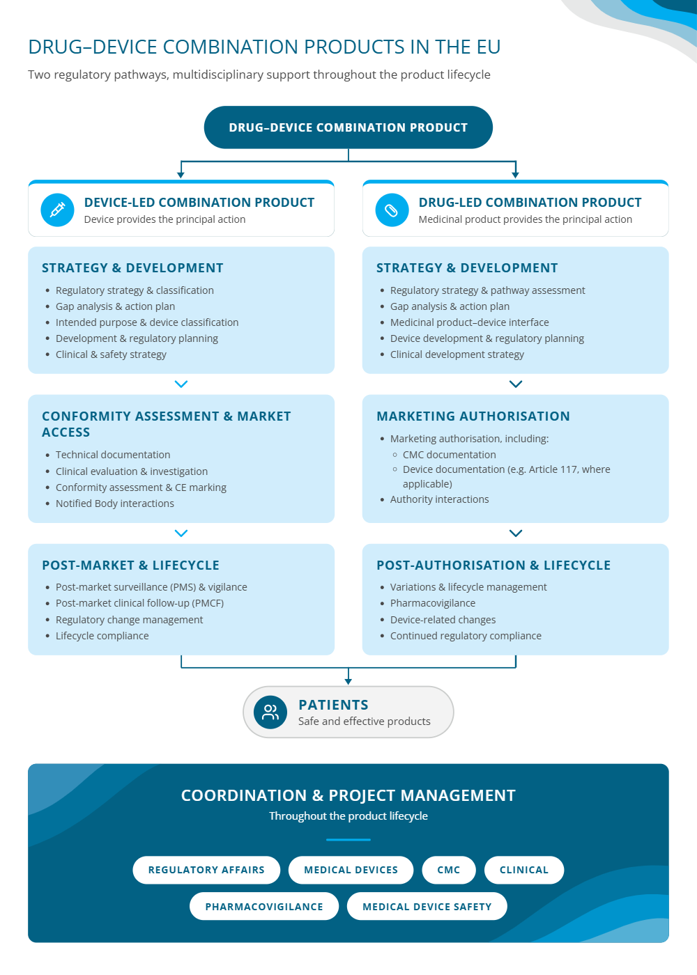
In industry, the two types of drug-device combination products are often referred to as drug-led and device-led products. Although these are useful practical terms, EU legislation focuses on the regulatory status of the product and the respective roles of its medicinal and device components. Determining the applicable regulatory pathway early can have important implications for development activities, documentation, clinical evidence, authority and Notified Body interactions, and the overall route to market.
What is a drug–device combination product?
In the European Union, drug–device combinations are not regulated as a single, separate product category. Instead, the applicable regulatory framework depends on the characteristics of the individual product and the respective roles of its medicinal and device components.
For products intended for human use, the applicable framework may primarily be the EU medicinal product legislation, including Directive 2001/83/EC, or the Medical Device Regulation (EU) 2017/745 (MDR). Veterinary medicinal products are governed separately under Regulation (EU) 2019/6.
Drug–device combinations can take many forms. Common examples include:
- pre-filled syringes
- auto-injectors
- insulin pens
- metered-dose inhalers
- wearable injectors
- drug-eluting stents
- transdermal patches
- certain nasal spray products.
Importantly, these examples do not all follow the same regulatory pathway. Similar-looking drug–device combinations may be subject to different requirements depending on their intended purpose and mode of action.
Is my combination product drug-led or device-led?
This is often one of the first regulatory questions in DDC development, and for a good reason. The answer has fundamental implications for which regulatory framework applies and how the product is developed, documented and assessed.
Although the terms drug-led and device-led are commonly used in industry, they are practical descriptions rather than defined regulatory categories under the medicinal product legislation and MDR.
Drug-led combination product
In a drug-led combination product, the medicinal product provides the principal action, while the device typically enables or supports its administration, delivery or dosing.
Depending on the specific product configuration, examples may include:
- pre-filled syringes
- auto-injectors
- certain insulin pens
- certain drug-containing inhalers.
These products are primarily regulated under medicinal product legislation, although relevant medical device requirements may also apply.
Device-led combination product
In a device-led combination product, the medical device provides the principal intended action and the medicinal substance incorporated into the device has an action ancillary to that of the device.
Examples may include:
- drug-eluting stents
- certain antimicrobial catheters
- other medical devices that incorporate an ancillary medicinal substance.
These products are regulated under the MDR, with specific requirements applying to the incorporated medicinal substance.
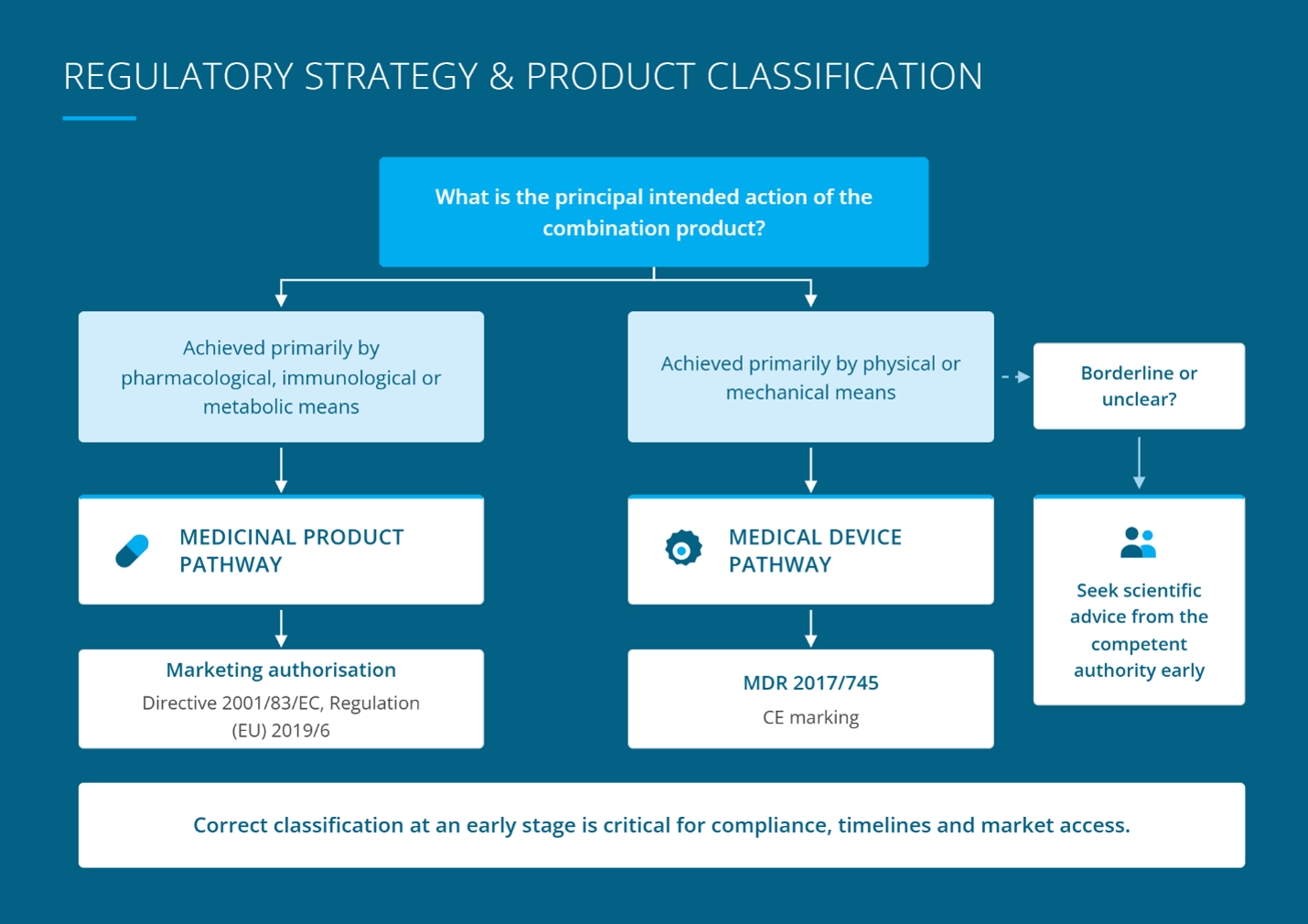
Five steps to assess the regulatory pathway for drug–device combination product
1. What is the intended purpose of the product?
Start with the manufacturer’s intended purpose and product claims, which provide the basis for determining the applicable regulatory framework.
2. What provides the principal action?
Identify how the product achieves its main intended therapeutic or diagnostic effect. Is this action primarily attributable to the medicinal product or to the medical device?
3. How does each component contribute to the intended action?
Consider how the medicinal and device components achieve or support the intended purpose, including their respective modes of action.
4. If a medicinal substance is incorporated into a device, is its action principal or ancillary?
A medicinal substance does not automatically make the product a medicinal product. If the device provides the principal intended action and the medicinal substance has an ancillary action, the product may fall under the MDR.
5. How are the medicinal product and device combined or supplied?
For medicinal product-led combinations, consider whether the device is integral, co-packaged or supplied separately, as this affects the applicable device requirements and documentation.
Borderline cases should be assessed based on the product as a whole. Addressing these questions early can help avoid the need for changes to the regulatory strategy later in development.
Is the device integral, co-packaged or obtained separately?
For medicinal product-led drug–device combinations, another important question is how the medicinal product and device are combined and supplied. The device may be:
- Integral: the medicinal product and device form a single integral product. Examples may include certain pre-filled syringes, auto-injectors and inhalers.
- Co-packaged: the medicinal product and device are separate items but supplied together as part of the same medicinal product presentation.
- Obtained separately: the medicinal product is intended to be used with a medical device that is obtained separately.
This distinction can affect the applicable device requirements and regulatory documentation.
For certain integral drug–device combinations, MDR Article 117 introduces specific requirements concerning evidence of compliance of the device part with the relevant General Safety and Performance Requirements. Article 117, Notified Body Opinions and device documentation for marketing authorisation applications will be discussed in Part 2 of this series.
Common pitfalls in drug–device combination product development
Based on Medfiles’ regulatory experience, we have identified several common pitfalls that can affect drug-device combination product development:
1. Determining the regulatory pathway too late
The pathway should be assessed early enough to guide development and evidence generation.
2. Treating the drug and device as separate development projects
Their interfaces, compatibility, performance and risks need to be considered as part of the overall product strategy.
3. Underestimating device requirements in drug-led products
Applicable device requirements should be identified early rather than addressed only towards the end of development.
4. Deciding the product configuration too late
Whether the device is integral, co-packaged or obtained separately can affect regulatory requirements and documentation.
How can Medfiles support your drug–device combination product?
Developing a drug–device combination product requires expertise in both medicinal product legislation and medical device regulation. With over 30 years of experience in medicines and over 15 years in medical devices, Medfiles brings together specialists from both fields to support an integrated regulatory strategy.
We help assess the applicable regulatory pathway, identify potential challenges early and support your product throughout its lifecycle – from development and clinical activities to marketing authorisation or CE marking and post-market activities. Our multidisciplinary expertise covers regulatory affairs, CMC, clinical research, pharmacovigilance and medical device safety.
Whether you need support with a specific regulatory question or a broader development project, our services can be tailored to your needs.
References:
- Regulation (EU) 2017/745 (MDR)
- EMA. Guideline on quality documentation for medicinal products when used with a medical device (EMA/CHMP/QWP/BWP/259165/2019).
- EMA. Medicinal products used in combination with a medical device.
- MDCG 2019-2. Guidance on application of UDI rules to device-part of products referred to in Article 1(8), 1(9) and 1(10) of Regulation (EU) 2017/745.