A pharmaceutical company that has successfully developed and marketed a Human Medicinal Product (HMP) may wish to repurpose the same active substance for use in animals as a Veterinary Medicinal Product (VMP) in Europe. However, this transition presents regulatory, scientific and market access challenges in adapting the existing product to meet veterinary-specific requirements under EU Regulation (EU) 2019/6. While HMPs and VMPs share many regulatory requirements, significant differences arise particularly in the areas of Chemistry, Manufacturing, and Controls (CMC) and Pharmacovigilance (PV).
In this blog post, Medfiles’ experts outline key regulatory considerations and practical steps for repurposing your human medicines for veterinary use.
Managing the transition from Human to Veterinary Medicinal Products in the EU
To enter the EU veterinary market, the company should initiate a tailored regulatory strategy that includes:
1. Gap Analysis & Regulatory Pathway
Conduct a detailed gap analysis comparing the existing human product dossier with the requirements under Regulation (EU) 2019/6 for VMPs. Determine the most suitable marketing authorisation route (e.g., centralised, decentralised, or national).
2. Preclinical and Clinical Development
Generate or adapt data demonstrating the product’s safety and efficacy for the target animal species. This may include pharmacokinetics, residue studies (if for food-producing animals), and species-specific toxicology.
3. Formulation and Dosage Adjustment
Modify the formulation and packaging as needed to suit veterinary use, considering factors like ease of administration, species-specific palatability (taste, smell and texture), and dose variation.
- Examples of matters to consider: Does your HMP formulation contain any excipients that are commonly used in human medicinal products, but which are considered toxic to some animals and thus not permitted in veterinary products? Is the chosen dosage form optimised for animal medication? What about the pack size? Do you need an additional dosing device? Has the elemental impurity risk assessment been re-evaluated to account for changes in maximum daily dose, animal species-specific exposure, and potential differences in administration routes or formulation? If you modify the formulation or packaging configuration, stability may need to be re-evaluated.
4. Environmental Risk Assessment (ERA)
The ERA for VMP is more comprehensive due to the direct release of these products into the environment, particularly through animal excretion. This assessment evaluates the potential impact on soil, water, and non-target organisms.
5. Residue Limits
There are specific requirements for establishing maximum residue limits (MRLs) in food-producing animals to ensure that residues of veterinary drugs in animal products are safe for human consumption.
6. Impurity risk assessments
Remember to update your impurity risk assessments in the quality part of the dossier, to reflect the target species, its size and maximum daily dosage of the drug and modify your control strategy accordingly, if needed.
7. Stakeholder Engagement
Collaborate with veterinary practitioners, regulatory consultants, and key opinion leaders to ensure clinical relevance and smooth market entry. The MAH also needs a local or regional representative for the purpose of receiving reports of suspected adverse events who can communicate in the local language. This is often arranged through distributors.
8. Pharmacovigilance system
In addition to Regulation (EU) 2019/6, pharmacovigilance for veterinary medicines in the EU and EEA is guided by Implementing Regulation (EU) 2021/1281 and the Veterinary Good Pharmacovigilance Practices (VGVP) modules.
- Creating a Pharmacovigilance System Master File (PSMF) specifically tailored for veterinary products is essential for monitoring safety and reporting adverse events in animals. Unlike human pharmacovigilance, veterinary pharmacovigilance requires species-specific reporting and involves different timelines for adverse event reporting. MAH must set up systems to capture and analyse events across various species, considering their physiological responses and impacts on welfare and food safety. Due to these differences, a single PSMF cannot be used for both human and veterinary medicines. Additionally, a veterinary surgeon must assist the qualified person responsible for pharmacovigilance (QPPV) unless the QPPV holds the relevant degree.
- When developing a veterinary pharmacovigilance system and related PV quality system, MAH needs to integrate veterinary-specific parameters into their data collection and risk management processes, including environmental factors and animal husbandry practices, especially for food-producing animals. Risk assessments should address veterinary-specific risks like zoonotic potential and impacts on human food consumption and also environmental aspects. The signal detection process for veterinary medicines differs notably from human medicines, requiring specialized approaches.
Regulatory comparison: Differences Between HMPs and VMPs
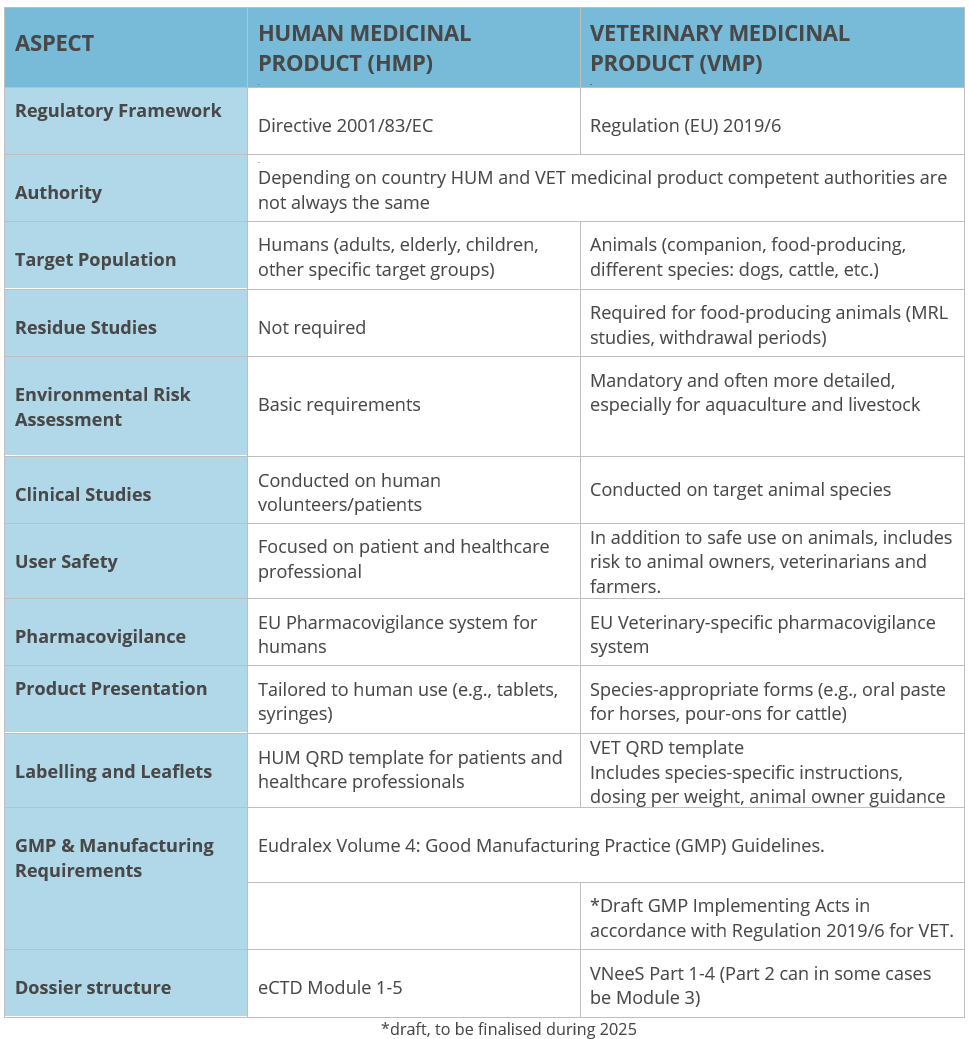
Transitioning from HMP to VMP starts with a thorough regulatory assessment to understand the specific guidelines for veterinary medicinal products. In the table below HMP and VMP features are compared:
Medfiles supports your journey in repurposing human medicines for veterinary use
Our dedicated team of experts specialises in veterinary medicinal products. We have extensive experience in preparing regulatory dossiers, managing marketing authorisations (CP, DCP/MRP and NP) and maintaining a comprehensive PV system throughout the EU and the UK. Additionally, we offer in-depth knowledge in CMC for VMPs, from product-development to Part II and Part IC.1 writing.
Our team is equipped to facilitate the transition from HMP to VMP. We are committed to helping you unlock new market opportunities and ensuring the safety and efficacy of your veterinary products.
For products initially developed as Human Medicinal Product and looking to enter the market as Veterinary Medicinal Products, we offer:
STRATEGIC REGULATORY ADVICE AND SUPPORT IN CHOOSING THE APPROPRIATE APPLICATION TYPE
COMPREHENSIVE SUPPORT IN CMC
We provide expert consultation for gap analyses when transferring your current human medicinal product (HMP) quality dossier to a veterinary medicinal product (VMP) quality dossier. Our team helps you plan and execute any additional development studies required, and we offer authoring support, dossier updates, or complete dossier preparation based on the available development data.
PART 1 ADMINISTRATIVE DOCUMENT AND PRODUCT INFORMATION PREPARATION AND COMPILATION
VNEES COMPILATION AND SUBMISSION
LIAISON WITH HEALTH AUTHORITIES AS NEEDED
PHARMACOVIGILANCE SERVICES
Our PV system includes a PV quality system, a pharmacovigilance database and a QPPV service to ensure safety monitoring, adverse reaction reporting, signal management and cooperation with authorities on an international level.
If the applicant does not have a legal entity in the EU, Medfiles can, under certain conditions, act as the marketing authorisation applicant or holder prior to product launch.
We would be happy to discuss your needs and explore potential solutions together!
Find out more about our team and read what our clients say about working with us:
- Meet Medfiles’ dedicated animal health team
- Vetcare & Medfiles: Working together on the maintenance of marketing authorisations and pharmacovigilance of veterinary medicines
- Vetcare & Medfiles: Centralised marketing authorisation process
- Bimeda & Medfiles: Partnership in veterinary regulatory affairs in the EU
Authors:

Eeva-Maija Walin
Senior Pharmaceutical Chemical (CMC) Expert
Eeva-Maija Walin joined the Medfiles CMC team in August 2019. She holds a Master’s degree in chemistry with additional studies in pharmacy and microbiology, and has nearly 20 years of prior experience in pharmaceutical CMC roles, mainly in R&D, quality control, and regulatory affairs.
At Medfiles, Eeva-Maija is responsible for CMC documentation related to veterinary medicinal products, including Part II and Part IC.1 writing, variation classification, gap analyses, and response strategies. Her work also includes project coordination and scientific consultation in complex regulatory cases.
With her broad experience across the product lifecycle and background in both science and regulation, Eeva-Maija bridges technical development and compliance.

Elina Krannila
Senior Regulatory Affairs Expert
Elina Krannila joined Medfiles in 2011 after graduating with a Master’s degree in pharmacy, specialising in industrial pharmacy. Since 2012, she has worked extensively with veterinary medicinal products alongside human medicines.
Elina is responsible for regulatory activities related to veterinary marketing authorisations in the EU, UK and US. Her work includes handling procedures such as CP, DCP, MRP, SRP and NP, as well as maintaining compliance with current legislation and regulatory guidance. She also supports communication with authorities and internal stakeholders throughout the regulatory process.
With over a decade of experience, Elina combines attention to detail with strategic planning, ensuring efficient and compliant regulatory pathways for veterinary products.

Saana Lamminjoki
Safety Manager
Saana Lamminjoki joined Medfiles Pharmacovigilance team in May 2021 and since then has been working with both human and veterinary PV activities in the EU and UK.
Currently Saana is responsible for operational leading of veterinary pharmacovigilance activities. Her day-to-day responsibilities for veterinary products include, for example, monitoring of published scientific literature, signal detection and management, risk management and evaluation and processing of adverse event reports from the EU, UK and third countries. Saana is actively involved in the maintenance of the Pharmacovigilance System Master File (PSMF) and the Quality Management System, ensuring that all veterinary SOPs and processes are compliant. She has also contributed to the set-up of the veterinary PV system.
With a bachelor’s degree in pharmacy and a master’s degree in general toxicology, Saana brings her knowledge and expertise to her role.